

Introducing Workforce Compliance: sector-focused training built for real workplace compliance
At Workforce Compliance, we believe compliance training should do more than issue a completion tick and hope for the best.
Too much of the market still treats compliance as a box-ticking exercise: a quick module, a multiple-choice quiz, a certificate, and everyone carries on pretending that competence has somehow been achieved. In the real world, employers know it is rarely that simple.
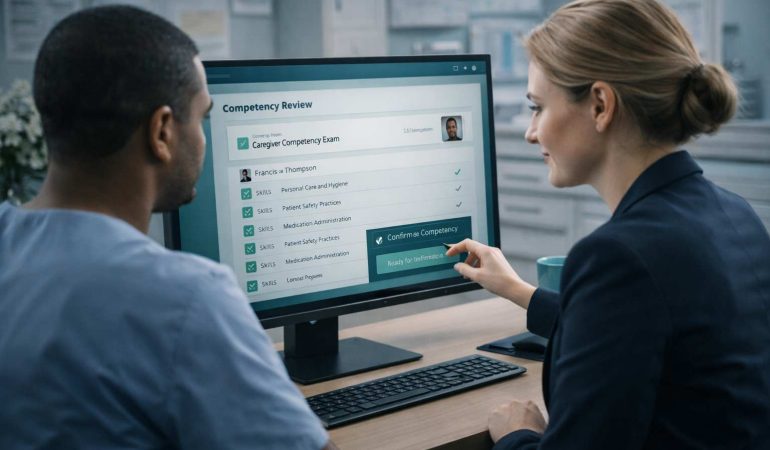
That is why Workforce Compliance is being built as a practical, employer-focused training brand designed around real operational needs. Our approach goes beyond generic e-learning by supporting structured learning, knowledge checks, scenario-based decision-making, supervisor involvement, and clearer evidence of completion and competence.
One brand, multiple specialist verticals
Workforce Compliance is our umbrella brand. Under it, we are developing sector-focused training ranges so employers and learners can access compliance learning that feels relevant to their world, not copied and pasted from somewhere else.
These verticals include:
Care
Training designed for care providers, care workers and support teams, including our specialist care-focused strand and wider sector-relevant compliance topics.
Dental
Training for dental teams and environments, including compliance areas relevant to clinical settings, patient-facing roles and practice operations.
Food Safety
Training for food handlers, hospitality teams, kitchens, catering operations and wider food business compliance needs.
Health & Safety and Workplace Compliance
Core workplace compliance training for employers across a wide range of sectors, including practical day-to-day training that supports safer working environments.
Veterinary Services
Training for veterinary environments, where compliance expectations span clinical practice, hygiene, safety, patient handling, administration and workplace procedures.
Wider professional and operational compliance
Additional sectors and course ranges will continue to be introduced where organisations need structured compliance training supported by clear standards, realistic application and stronger governance.
Why this matters
Different sectors face different risks, different expectations and different working realities.
A care setting is not a dental practice.
A veterinary environment is not a warehouse.
A food operation is not an office.
So the training should not feel identical.
Our model allows us to build training that is better aligned to the environments in which people actually work, while still maintaining a consistent standard of quality, structure and compliance focus across the wider brand.
What makes Workforce Compliance different
Our aim is to provide training that supports more than passive completion.
Depending on the course and sector, our approach may include:
- structured e-learning that explains the subject properly
- knowledge checks to confirm understanding
- scenario-based learning that explores judgement and decision-making
- supervisor sign-off where workplace competence matters
- clearer reporting and governance support for employers
- sector-specific framing rather than generic off-the-shelf copy
In short, we are building training for organisations that want something more credible than tick-box compliance.
Built for employers, not just learners
Workforce Compliance is designed with employers in mind.
That means thinking beyond the learner screen and considering the wider compliance picture: allocation, evidence, completion, progression, supervision, reporting and operational confidence.
For many organisations, the challenge is not simply finding a course. It is being able to show that training has been delivered in a way that supports safer, more consistent practice across teams.
That is the standard we are working toward.
What is coming next
As the platform grows, we will continue expanding our sector coverage and course catalogue across the verticals above, with a focus on practical relevance, stronger learning design and professional presentation.
Some areas will launch sooner than others, but the direction is clear: one umbrella brand, multiple specialist verticals, and a more credible approach to compliance training.
Take the next step with Workforce Compliance
Explore our training, follow Workforce Compliance for updates, or get in touch
to discuss your organisation’s compliance needs.